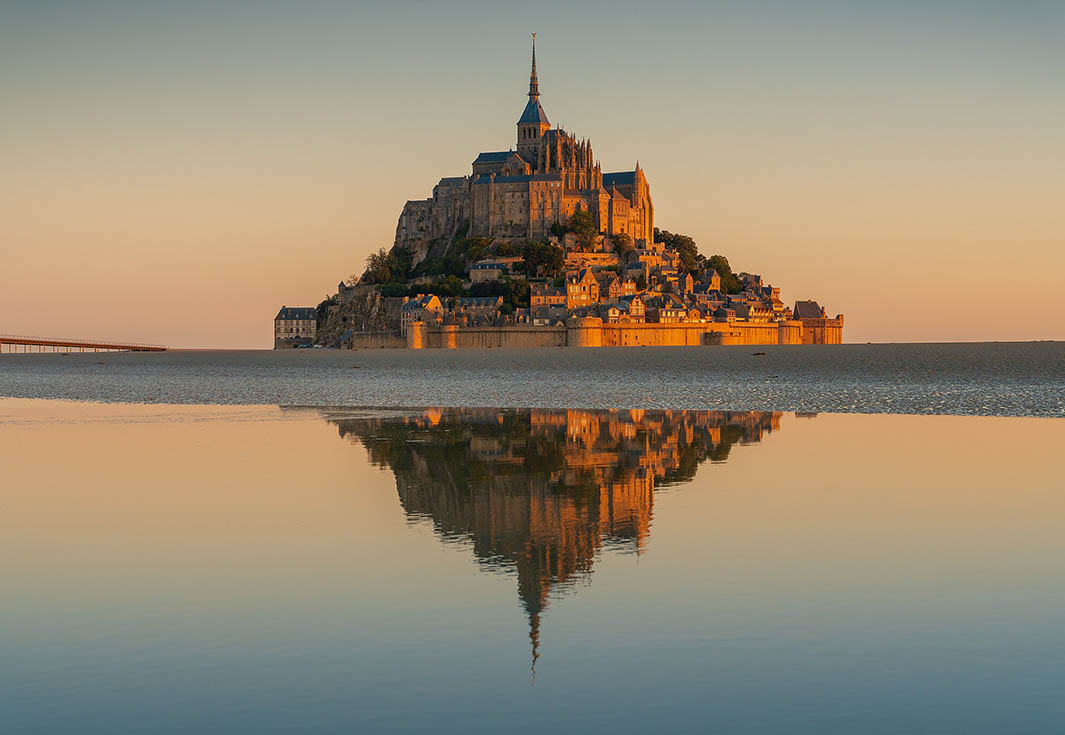
I first heard of Mont Saint-Michel through a photograph: a solitary island topped by a spire-like abbey, encircled by the tides—appearing as if it were floating somewhere between the sea and the sky. In that very moment, I resolved that if I ever had the opportunity to travel to France, this place would absolutely have to be one of my destinations.
Yet, when I finally stood before it in person, I realized that no photograph could ever fully capture its awe-inspiring power; it is not merely a tourist attraction, but rather a miracle forged jointly by nature and humanity.
A First Glimpse of the Maritime Wonder: A Castle Emerging from the Distance
When I arrived at the coast of Normandy, the air was cool and damp, carrying the briny moisture of the sea breeze. Gazing into the distance, I spotted a faint silhouette at the edge of the horizon—resembling a hill floating upon the water. I knew, instantly, that this was Mont Saint-Michel.
As the bus drew closer, the “island” began to take shape with increasing clarity: a base of gray rock, a dense cluster of stone houses, and—crowning it all—the abbey’s spire, pointing directly toward the heavens. The visual impact was immediate and profound, leaving me momentarily speechless.
After disembarking at the parking area, I chose to make the final approach to the island on foot. A paved walkway stretched across the tidal flats, flanked by vast expanses of open terrain bearing the alternating traces of land and sea. The wind blew strong and salty—a bracing gust against my face that felt invigorating. With every step I took closer, the island seemed to grow more surreal, as if it had stepped right out of the pages of a history book.
The Town’s Cobblestone Streets: A Gateway to the Middle Ages
Passing through the town gates, I officially entered the Rue Principale—the town’s main cobblestone street.
The street was exceedingly narrow, paved entirely with stone slabs and flanked on both sides by layers of ancient buildings stacked one atop the other. Many of the houses tilted upward at an angle, as if their spines had been gently bowed by the sheer weight of time. Lining the street were souvenir shops, restaurants, inns, and small boutiques selling local delicacies such as sea-salt caramels and apple cider.
Although the street was bustling with tourists, the atmosphere never felt chaotic. Precisely because of the street’s narrow dimensions, the flow of people was naturally channeled upward, guiding everyone along the same winding path. I ascended slowly; with every step, I could hear the sound of my soles striking the cobblestones—a rhythmic clack-clack that created the illusion of stepping back in time.
I paused at a small shop to buy a piece of sea-salt caramel. The sweetness spread slowly across my palate, yet it carried a subtle hint of saltiness—a flavor that suddenly made me understand the true taste of the Normandy coast. It is not merely a singular sweetness or bitterness, but rather a complex sensation born from the union of sea and land.
Continuing my ascent, the streets grew progressively steeper. The gaps between the buildings narrowed until the sky above was reduced to a mere slender ribbon. In that moment, I was struck by a powerful sensation: I was walking into a “vertical city.”
The Abbey (Abbaye du Mont-Saint-Michel): The Gateway to the Edge of the Sky
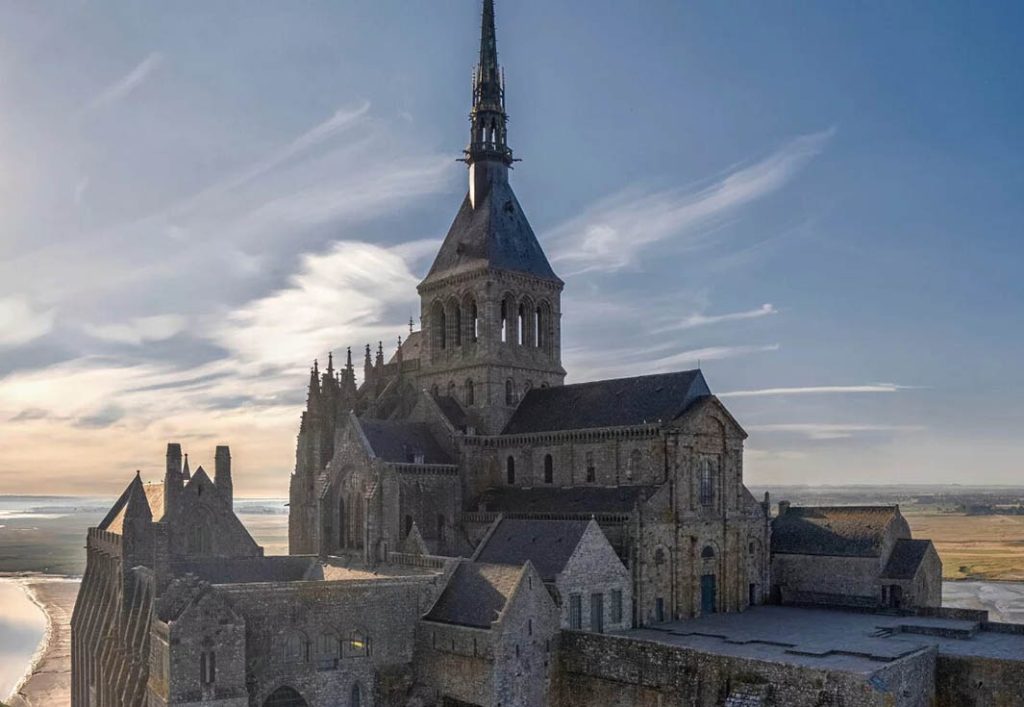
Finally, I reached the island’s highest point—the Abbey of Mont-Saint-Michel.
Standing at the entrance, I gazed up at the structure. It resembled neither a conventional church nor a typical monastery; instead, it appeared as a colossal edifice fused inextricably with the very rock upon which it stood. Its stone walls rose in cascading layers, and its spires pierced the heavens, as if striving to bridge the divide between humanity and the sky.
Upon entering the Abbey, the interior space gradually fell silent. The massive stone walls muffled the sounds of the wind and the crowds outside, leaving only the echo of my own footsteps reverberating through the long corridors.
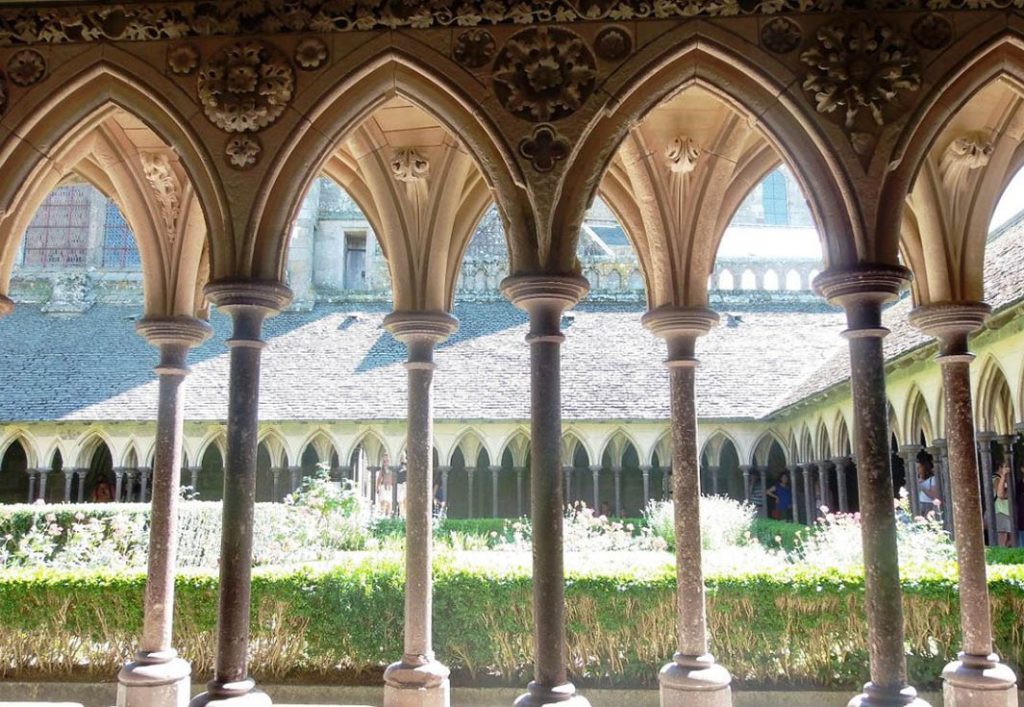
I passed through one hall after another: the prayer chapel, the cloister, and the site of the former refectory. Light streamed in through high windows, casting long, luminous bands across the stone floors. It was not a warm light, but rather one imbued with a sense of solemn serenity—a quality that compelled me, almost unconsciously, to slow my breathing.
What left the deepest impression on me was the cloister. Surrounded by exquisite stone columns and graceful arches, it enclosed a small, central garden. The wind whispered through the arches, carrying with it the scent of the sea. Standing there, I suddenly understood why the monks had chosen such a place for their spiritual practice—it was a sanctuary that simultaneously stood apart from the world and remained intimately connected to the natural realm.
The Tidal Viewpoint: The Rhythmic Dance of Time and Tide
Leaving the Abbey behind, I made my way to the Tidal Viewpoint.
The most breathtaking aspect of Mont-Saint-Michel is not merely the architecture itself, but rather its profound relationship with the tides. At different times, the island is encircled by the sea, appearing to float amidst the waves; yet at low tide, it reconnects with the mainland, revealing vast stretches of mudflats.
I stood on the observation deck, waiting for the tide to turn. The wind began to pick up, clouds drifted ceaselessly across the sky, and the interplay of light and shadow shifted rapidly across the ocean’s surface. In the distance, the water began to rise slowly, as if propelled by some invisible force.
Locals told me that the tidal shifts here occur with remarkable speed—sometimes, the transformation from a connected landmass into an isolated island can take place within just a few hours. As I listened, I kept my eyes fixed on the distant waterline, feeling a curious blend of both nervousness and anticipation.
As the seawater gradually enveloped the island, I witnessed Mont Saint-Michel truly transform into an “isolated fortress at sea.” In that moment, it ceased to be merely a tourist attraction; instead, it felt like an entity floating adrift in time itself.
Dining on the Island: Simple, Authentic Flavors
While on the island, I chose to dine at a small, local restaurant. The menu was uncomplicated, featuring primarily seafood, lamb, and other local ingredients.
I ordered a dish of Norman-style lamb accompanied by a glass of cider. The lamb was tender and soft, carrying a subtle hint of herbs, while the cider was crisp and slightly tart—the perfect refreshment for such a breezy, windswept setting.
My table was situated by the window, offering a view of the tidal flats outside and the shifting waters in the distance. As I ate, I watched the rising tide slowly reclaim the land that had moments before been exposed—it felt akin to watching a natural theatrical performance unfold before my eyes.
The meal lacked elaborate plating or gourmet presentation, yet it left me with a lasting impression of its “sense of place”—a profound feeling that the food and the natural world were unfolding in perfect harmony.
Mont Saint-Michel by Night: An Isolated Island Bathed in Light
As dusk fell and the crowds of visitors gradually dispersed, the island settled into a profound silence.
Rather than departing, I chose to remain at an observation point just off the island to await the arrival of the nightscape.
One by one, the lights began to glow, rendering the abbey even more majestic against the backdrop of the night sky. Its stone walls were illuminated by a soft, gentle light, appearing like a silhouette floating within the darkness. The surface of the sea lay pitch black, reflecting only the occasional glimmer of light from the shore.
The wind continued to blow fiercely, yet in this moment, Mont Saint-Michel appeared both more solitary and more beautiful than ever before.
I stood there for a long time, silent and motionless, simply watching it exist—quietly and steadfastly—within the embrace of the night.
A Backward Glance Upon Leaving: Memories Between the Sea and Time
On the day I departed Mont Saint-Michel, the tide had receded, and the causeway had re-emerged. I turned to look back at the island; it still stood tall in the distance, yet in the morning light, it appeared far gentler.
I suddenly realized that the most unique aspect of this place lies not in what it resembles, but rather in its ceaseless state of flux—the ebb and flow of the tides, the interplay of light and shadow, and the fleeting connection between humanity and nature.
On this island, I perceived not merely a monastery and stone structures, but a distinct rhythm in the passage of time.
As the vehicle slowly pulled away, that maritime marvel gradually diminished in size, eventually merging into the horizon. Yet, the imagery it left behind remains indelibly vivid—the solitary island, the tides, the wind, and that sense of tranquility that can never be replicated.
The Imprint of Tides and Time: My Memories of Mont Saint-Michel
Mont Saint-Michel is no mere tourist attraction; it is an experience—one that allows you to sense the passage of time amidst the tides, to touch history upon its cobblestone streets, and to find solace in the silence of its monastery.
It was only after I had departed that I truly understood: the beauty of certain places lies not in what you see, but in how the world transforms you during the time you spend there.